← Back to Insights
6bfb0a5db96e32162ee162ef2729c78d
June 22, 2026
Choosing sustainability reporting software is no longer a back-office IT decision — it's a compliance decision. As regulations like the EU's CSRD, California's SB 253/261, and investor-driven frameworks like the ISSB push more mid-sized companies toward mandatory carbon disclosure, the software you pick determines whether your greenhouse gas (GHG) inventory will actually hold up to scrutiny. A tool that produces a nice dashboard but can't trace its Scope 3 numbers back to a defensible calculation methodology will leave you exposed during an audit, a due diligence review, or a regulator's request for evidence.
This guide walks through exactly what to look for in sustainability reporting software if your priority is GHG Protocol alignment, accurate Scope 3 measurement, and audit-ready output — not just a pretty report.
The GHG Protocol Corporate Standard is the foundation almost every carbon disclosure framework builds on, including CSRD's ESRS E1, the SEC's proposed climate rules, SBTi target-setting, and CDP scoring. If your software isn't built around GHG Protocol methodology from the ground up, every downstream report — CDP, CSRD, SBTi, customer questionnaires — inherits that weakness.
When evaluating a platform, ask vendors directly:
If a vendor can't answer these clearly, treat it as a red flag. Many tools market themselves as “ESG platforms” while actually being survey or data-collection tools with a thin carbon calculation layer bolted on. That distinction matters enormously once an auditor or assurance provider starts asking how a number was derived.
Scope 3 typically accounts for 70–90% of a company's total emissions, yet it's the category most software handles poorly. The reason is structural: the GHG Protocol Corporate Value Chain (Scope 3) Standard spans 15 categories — purchased goods and services, capital goods, business travel, employee commuting, use of sold products, end-of-life treatment, and more — and each category often requires a different calculation method and a different data source.
1. Multiple calculation methods per category, not just spend-based averages.
Spend-based estimation (emissions = dollars spent × an industry average emission factor) is the easiest method to implement, which is why so many platforms default to it. But it's also the least accurate, because it assumes every dollar spent in a category has the same carbon intensity regardless of supplier. Software that meets a real accuracy bar should support:
A platform that only offers spend-based calculation cannot produce a Scope 3 inventory that will satisfy CDP's data quality scoring or an assurance provider's reasonable-assurance threshold.
2. Category-by-category data quality scoring.
The GHG Protocol's data quality framework rates inputs across factors like technological, geographical, and temporal representativeness. Software worth buying will flag which of your 15 Scope 3 categories rely on weak (spend-based, proxy) data versus strong (supplier-specific, measured) data, so you know where to invest in better data collection next.
3. Supplier engagement built in, not bolted on.
Since most Scope 3 emissions sit upstream in your supply chain, the software needs a structured way to request primary data from suppliers — automated outreach, standardized data templates, and a way to track response rates over time. Without this, “improving Scope 3 accuracy” stays a manual, spreadsheet-driven chase every reporting cycle.
4. Boundary-setting and category relevance screening.
Not every company needs to calculate all 15 Scope 3 categories with equal rigor. Good software helps you run a relevance screening (based on GHG Protocol guidance) to determine which categories are material to your business, then lets you document why others were excluded or estimated more coarsely — which is exactly what an auditor will ask to see.
A surprising number of sustainability platforms are built for self-reporting, not for the assurance process that increasingly accompanies it (CSRD, for instance, mandates limited assurance starting in the first reporting wave, moving to reasonable assurance later). Audit-ready software needs to do more than calculate a number — it needs to prove how the number was reached. See the full evaluation checklist below for a side-by-side comparison framework.
Look for:
If a tool can't produce an audit trail down to the activity-data level, it's a reporting dashboard, not compliance infrastructure.
If this is your company's first greenhouse gas inventory, the temptation is to either over-engineer it (trying to perfect Scope 3 from day one) or under-engineer it (a spreadsheet that won't scale past one reporting cycle). Neither works well. A practical sequence:
This is the difference between a one-off carbon estimate and a sustainability reporting system — and it's why the software choice matters more than most companies initially expect.
For a growing business facing a real deadline — a customer questionnaire, an investor request, or an upcoming regulatory threshold — speed matters, but speed without rigor just creates rework. The fastest legitimate path looks like this:
Done this way, a mid-sized company can typically produce a credible first GHG inventory and report within a single quarter, with a clear, documented path to tightening Scope 3 accuracy in subsequent years — rather than waiting a year to get everything “perfect” before reporting anything at all.
When comparing vendors, score each on:
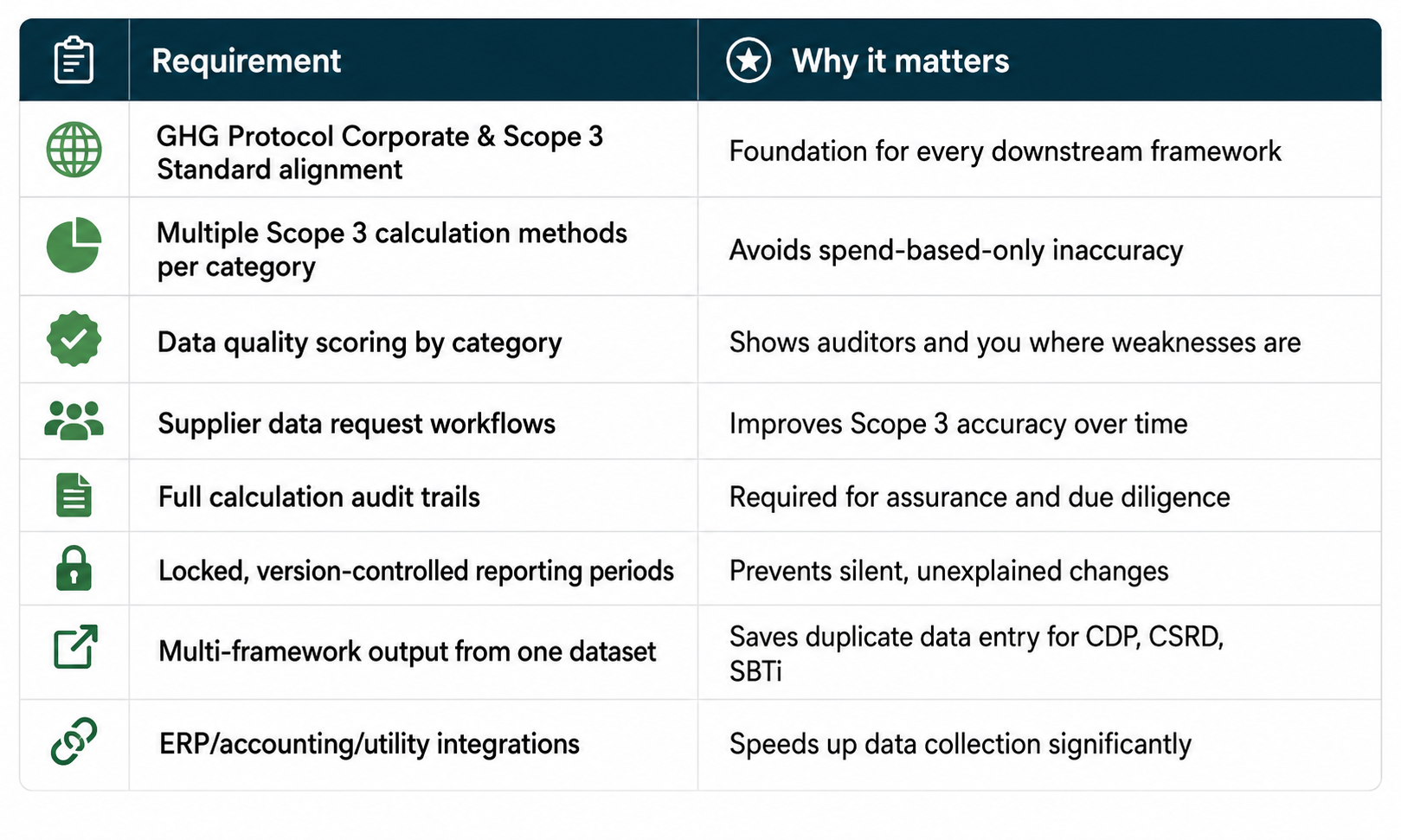
If you're evaluating sustainability reporting software and want a second opinion on whether a platform's Scope 3 methodology and audit trail will actually hold up to CSRD, CDP, or SBTi scrutiny, talk to our team. We'll walk through your current data sources, flag where spend-based estimates are masking real risk, and show you what a GHG Protocol-aligned inventory looks like for a company your size — no generic demo, just your numbers.
What is GHG Protocol-aligned sustainability reporting software?
It's software whose emissions calculations follow the GHG Protocol Corporate Accounting and Reporting Standard (Scope 1 and 2) and the Corporate Value Chain Standard (Scope 3) — the methodology nearly every other disclosure framework, including CSRD, CDP, and SBTi, is built on. Alignment means the tool supports the correct consolidation approaches, both location- and market-based Scope 2 reporting, and sourced, version-controlled emission factors.
How do I measure Scope 3 emissions accurately?
Use the most precise calculation method available for each of the 15 Scope 3 categories — supplier-specific or hybrid data where possible, activity-based average-data methods next, and spend-based estimates only as a fallback. Run a relevance screening to focus effort on material categories, track data quality category by category, and build supplier data collection into your ongoing process rather than treating it as a one-time exercise.
Can spend-based Scope 3 estimates be audited?
Yes, but with caveats. Spend-based figures can pass a first-year limited assurance review if clearly documented as estimates with a stated methodology and emission factor source. They become a liability if left in place indefinitely or presented as equivalent in accuracy to supplier-specific data — auditors and frameworks like CDP score data quality, and weak Scope 3 categories will be flagged.
How long does it take a mid-sized company to build its first GHG inventory?
With GHG Protocol-aligned software, pre-built calculation logic, and direct integrations to accounting/ERP/utility data, a credible first inventory and report is typically achievable within a single quarter. Full Scope 3 precision across all categories usually takes multiple reporting cycles to mature.
Do I need third-party assurance for my emissions report?
It depends on your regulatory exposure. CSRD mandates limited assurance in its initial reporting phase, moving toward reasonable assurance over time; other frameworks like CDP and voluntary SBTi commitments don't currently require it but increasingly reward it. Even if assurance isn't required yet, choosing software with full audit trails now avoids a costly platform switch later.
What's the difference between operational control and equity share consolidation?
Operational control means you report 100% of emissions from operations you control, regardless of ownership percentage. Equity share means you report emissions in proportion to your ownership stake. The GHG Protocol allows either, but you must pick one and apply it consistently — switching later requires recalculating prior years.
Get Aclymate's practical sustainability content delivered weekly.

Compare the best sustainability certifications for SMBs, including B Corp, SBTi, EcoVadis, CDP, ISO 14001, and more. Learn costs, requirements, carbon reporting needs, and which certification fits your business.
Read Article
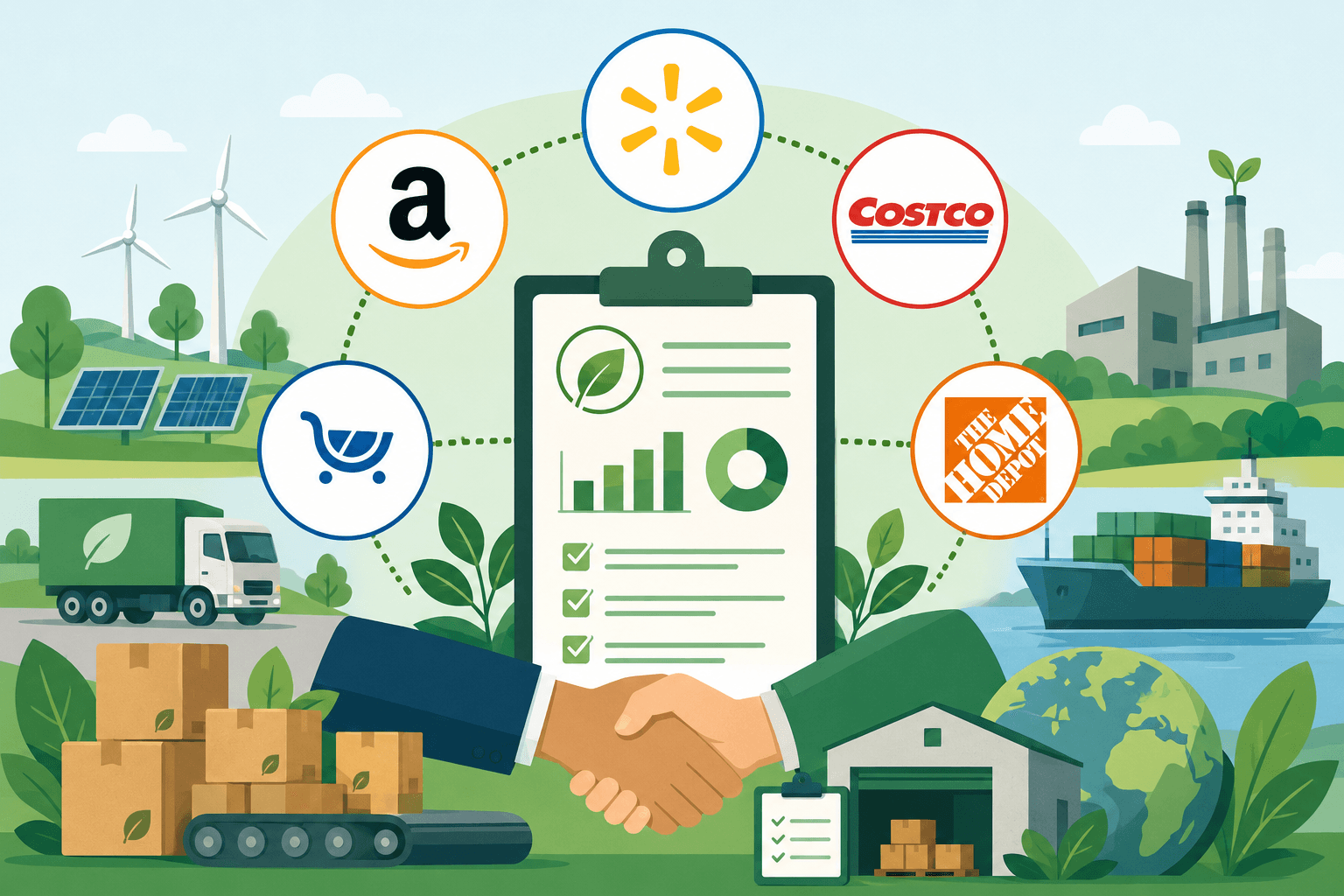
Selling to Walmart, Amazon, Costco, Kroger, or Home Depot? Each retailer has distinct sustainability and carbon reporting expectations for suppliers. This guide breaks down exactly what each retailer requires, what platforms they use, and how to prepare your emissions data before the next vendor review.
Read Article

Getting requests for your company's sustainability data from customers, partners, or procurement teams? This practical guide walks you through exactly what to measure, how to organize your emissions data, and how to respond to common sustainability questionnaires without hiring a full ESG team.
Read Article
Talk with a Sustainability Expert, see a demo, or start free to put the Aclymate platform and experts to work for your team.