← Back to Insights
6bfb0a5db96e32162ee162ef2729c78d
June 21, 2026
If you run a small or mid-sized business, sustainability certifications used to feel like something only large corporations pursued. That has changed. In 2025, a certified B Corp can be a two-person design studio. An ENERGY STAR-certified facility can be a regional warehouse. And a company with a Science Based Target can be a 30-person manufacturer.
The shift is being driven by real commercial pressure. Enterprise customers are asking suppliers to complete EcoVadis assessments. Retailers like Walmart and Amazon are requiring emissions data through their supply chain programs. Investors and lenders are screening for verified sustainability credentials. And regulators in California, New York, and the EU are tightening disclosure requirements for companies of all sizes.
This guide covers the eight most practical sustainability certifications for SMBs — what each one requires, what it costs, how it connects to carbon accounting, and how it can help you win more business. For context on what major retailers specifically expect from suppliers, see our guide on retailer sustainability reporting requirements for suppliers.
The business case for pursuing a sustainability certification has shifted from reputational to commercial. Here is what is driving the change.
Supply chain pressure from large retailers and customers. Enterprise procurement teams are embedding sustainability criteria into vendor qualification processes. Many now require suppliers to hold a recognized certification or complete an assessment like EcoVadis before a contract is awarded. Suppliers without any sustainability credentials are increasingly screened out before they reach a commercial conversation.
Regulatory expansion. California's SB 253, the EU's Corporate Sustainability Reporting Directive, and the SEC's climate disclosure framework are all tightening requirements for large companies to report supply chain emissions. That pressure cascades to their suppliers. Having a certified baseline makes compliance easier and cheaper as requirements expand.
Greenwashing risk. Sustainability claims that are vague or unsubstantiated carry growing legal and reputational risk. Third-party certification gives your environmental claims credibility that internal marketing cannot.
Talent and capital access. ESG-focused investors and green loan programs increasingly favor businesses with verified sustainability credentials. Employees, particularly younger workers, prefer employers with credible environmental and social commitments.
Not all certifications are equally relevant for small and mid-sized businesses. Some carry enormous brand weight but take 12 or more months to achieve. Others are practical entry points that build toward larger programs. Here is what you need to know about each one.
Issued by: B Lab | Annual fee: $1,000–$6,000+ (revenue-based) | Recertification: every 3 years | Timeline: 6–18 months
B Corp certification is the gold standard for businesses that want to demonstrate a comprehensive commitment to social and environmental performance. Run by the nonprofit B Lab, the program evaluates your entire company across five impact areas: Workers, Community, Environment, Customers, and Governance. In April 2025, B Lab launched its most significant standards overhaul, replacing the flexible 80-point B Impact Assessment model with mandatory minimum requirements across seven impact topics. Companies applying from 2026 must certify under the new V2.1 standard.
B Corp is particularly valuable for consumer-facing businesses where brand values influence purchase decisions. As of early 2025, there are roughly 9,576 certified B Corps across 160 industries in 102 countries.
B Corp: What SMBs Need to Know
Issued by: Science Based Targets initiative | SME validation fee: Free | Commitment window: 24 months | Review: every 5 years
SBTi does not certify your entire business — it validates your climate targets, specifically confirming that your emissions reduction goals align with limiting global warming to 1.5°C. As of January 2026, more than 10,000 companies hold SBTi-validated targets, a number that grew 40% in 2025 alone. The SME validation route is free and less complex than the full corporate pathway. SMEs are not required to set Scope 3 near-term targets, making it accessible for businesses with limited supply chain data.
SBTi is particularly valuable if your enterprise customers are beginning to require net-zero alignment from their supplier base. A validated SBTi commitment signals that your decarbonization goals are credible and independently reviewed.
SBTi: What SMBs Need to Know
Issued by: International Organization for Standardization | Certification cost: $5,000–$30,000+ | Annual surveillance audits | Recertification: every 3 years
ISO 14001 is the world's most widely adopted environmental management system standard, with over 360,000 certifications across 171 countries. It provides a framework for systematically identifying, managing, and reducing your environmental impacts. For SMBs, ISO 14001 is the most demanding certification on this list — typically requiring certified consultants, extensive documentation, and annual surveillance audits by an accredited certification body. That said, it carries strong credibility in industrial and B2B sectors and is often required for government contracts and large-enterprise supply chains.
ISO 14001: What SMBs Need to Know
Issued by: EcoVadis | Annual cost: ~$500–$2,000 | Results timeline: 6–8 weeks | Renewal: annual
EcoVadis is not a traditional certification — it is a sustainability ratings platform used by thousands of enterprise procurement teams to screen their suppliers. Companies like GM, AstraZeneca, and L'Oreal require EcoVadis ratings from their vendor base. If you sell to large companies, there is a meaningful chance you will receive an invitation to complete an EcoVadis assessment. EcoVadis rates businesses on 21 indicators across four themes: Environment, Labor and Human Rights, Ethics, and Sustainable Procurement. Strong performers receive Bronze, Silver, or Gold medals.
If you receive an EcoVadis invitation from a customer, responding is effectively mandatory if you want to retain that business. Annual renewal creates an ongoing benchmark that rewards documented improvement year over year.
EcoVadis: What SMBs Need to Know
Issued by: U.S. Environmental Protection Agency | Application cost: Free | Scope: buildings and facilities | Recertification: annual
ENERGY STAR is a U.S. EPA program that certifies commercial buildings and facilities that perform in the top 25% for energy efficiency in their category. The program is free, widely recognized, and directly tied to measurable energy and carbon reductions. Certification requires measuring your building's energy performance through EPA's free Portfolio Manager tool and achieving a score of 75 or higher out of 100. Annual recertification ensures ongoing performance.
ENERGY STAR is one of the most accessible sustainability credentials for any SMB with a physical location. It is also particularly valued in government procurement contexts, where energy efficiency is increasingly a qualifying criterion.
ENERGY STAR: What SMBs Need to Know
Issued by: Green Business Benchmark (formerly Green Business Bureau) | Annual fee: $500-$2,500 | Points-based, flexible path | Timeline: 3-6 months
Green Business Benchmark — known for years as Green Business Bureau — is one of the most SMB-friendly sustainability certification programs available. It provides a roadmap for businesses looking to get started with sustainability or improve their current sustainability practices. Unlike ISO 14001 or B Corp, GBB uses a progressive improvement model. Its certification process is entirely online and initiative-based, drawing from a library of over 400 green initiatives, so a company earns points for each completed activity — from switching to LED lighting to implementing a formal waste reduction program. Your certification level reflects your current standing while rewarding continuous improvement. Members gain points with every initiative they complete and can earn higher EcoScores, which correspond to higher certification levels: Member, Bronze, Silver, Gold, and Platinum.
GBB is an ideal starting point for businesses that haven't previously tracked sustainability performance and want a structured, achievable path into certification. Achieving GBB certification can also give you a foundation on which to apply for other green business certifications specific to your industry or products.
Green Business Benchmark: What SMBs Need to Know
Issued by: The Change Climate Project | Fee: revenue-based | Annual reduction targets required | Recertification: annual
Formerly known as Climate Neutral Certified, The Climate Label is issued by The Change Climate Project, a nonprofit that requires businesses to measure their emissions, set reduction targets, and fund climate transition projects proportional to their footprint. The 2025 Climate Label Standard introduced a Climate Transition Budget, calculated by applying a standard carbon fee to a company's total emissions — creating financial accountability for decarbonization rather than simply permitting offset purchasing.
The Climate Label is particularly well-suited for consumer-facing brands that want a visible, credible carbon commitment on their packaging or website. It is one of the most rigorous carbon-focused certifications available to SMBs.
Climate Label: What SMBs Need to Know
Issued by: CDP | Cost for SMEs: Free | Scored A–D | Submission deadline: June annually
CDP is technically a disclosure framework, not a certification — but it functions like one in practice. A CDP score is increasingly requested by enterprise customers, investors, and large retailers as proof of sustainability transparency. Amazon aggregates CDP responses directly from invited suppliers. Costco expects supplier participation in CDP. A strong CDP score — particularly a B or above — carries real market credibility and can satisfy multiple retailers' reporting requirements in a single submission.
SMEs can respond to CDP for free and receive an annual score ranging from A (Leadership) through D (Disclosure only). Because CDP responses are publicly available, a strong score also functions as a marketing asset.
CDP: What SMBs Need to Know
The table below summarizes the key details of all eight certifications to help you compare options.
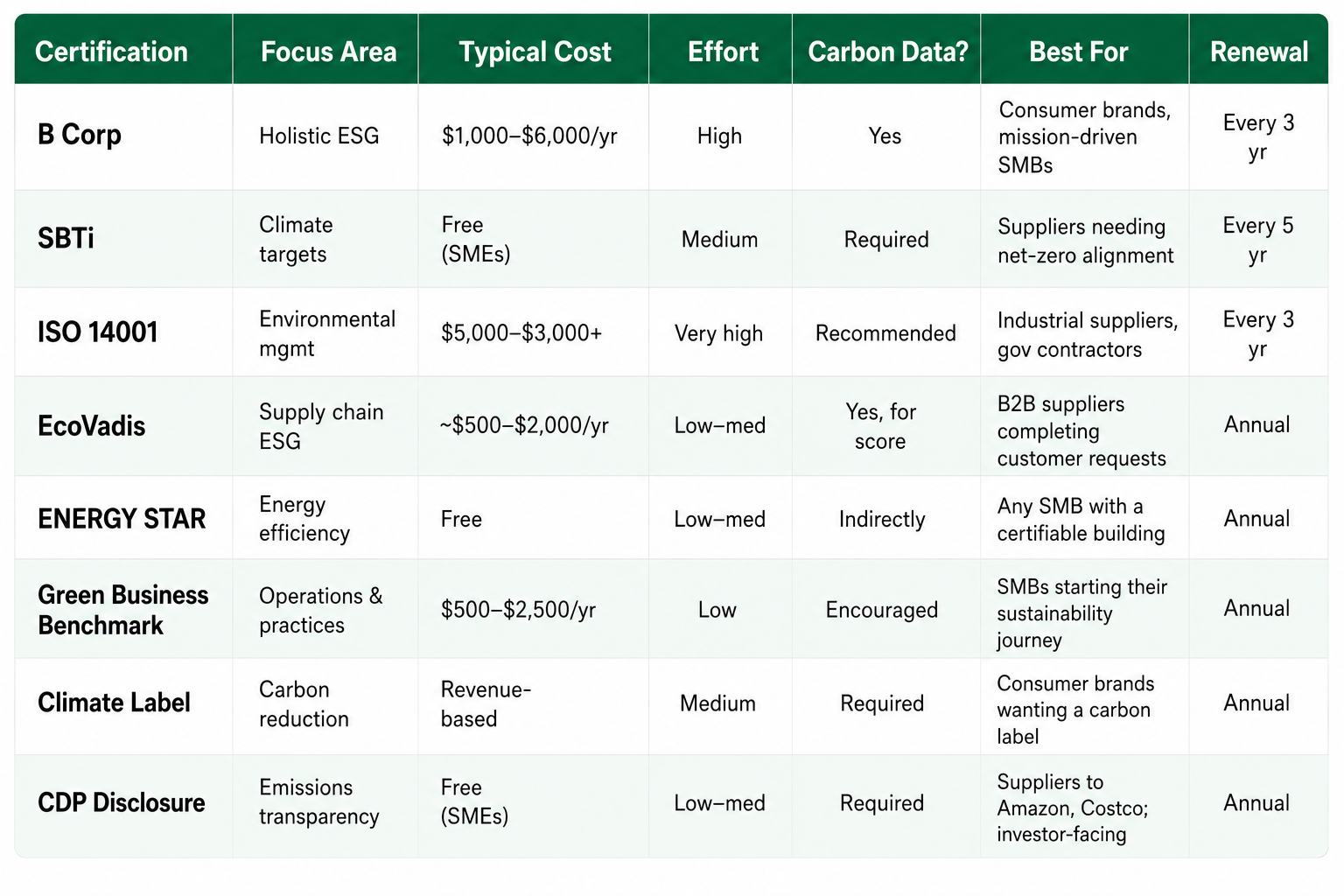
With eight credible options available, the key is matching your choice to your specific commercial situation. Here is a practical framework for making that decision.
Start with your customers' requirements. If your biggest customer sends you an EcoVadis invitation, that decision is effectively made. If a retailer is asking for your carbon footprint and supplier emissions data, CDP or SBTi may deliver the most direct value. Follow the commercial signal first.
Match effort to capacity. ENERGY STAR and CDP are free and self-service. B Corp requires 6 to 18 months of internal effort. ISO 14001 typically requires a consultant. Be honest about what your team can absorb before committing.
Build your data foundation first. Most certifications require a documented emissions inventory as a starting point. Establishing your Scope 1 and 2 baseline with a tool like Aclymate before beginning any certification process will save significant time and reduce the risk of data gaps during review.
Consider which certifications reinforce each other. A CDP disclosure supports EcoVadis. An ENERGY STAR building supports your GBB score. A single Aclymate emissions report provides the data needed for B Corp, SBTi, CDP, and the Climate Label simultaneously.
Plan for year-over-year improvement, not just initial certification. GBB's progressive model and CDP's annual scoring both reward documented improvement over time. The most credible sustainability programs are ones you maintain and build on, not one-time achievements.
There is one requirement that appears in nearly every sustainability certification on this list: documented, GHG Protocol-aligned carbon emissions data. Not a narrative description of your green initiatives. Not a commitment to measure someday. Actual numbers, calculated using a recognized methodology.
Here is how that requirement appears across each certification:
The practical implication: if your business has not yet measured its carbon footprint, that is not a reason to delay certification — it is the first step toward it. A documented Scope 1 and 2 inventory, calculated using GHG Protocol methodology, is the single most transferable piece of sustainability data your business can produce. It feeds into every program on this list.
Sustainability certifications are increasingly a direct commercial asset, not just a reputational signal. Here is how SMBs are using them to win contracts and retain customers.
A growing number of enterprise procurement teams require suppliers to hold a recognized certification or complete an EcoVadis assessment before a contract is awarded. Suppliers without sustainability credentials are increasingly screened out before they ever reach a commercial conversation. Having even a CDP disclosure or a GBB certification signals that you are a credible, forward-looking supplier.
Federal and state procurement is incorporating Buy Clean requirements and sustainability screening criteria with increasing frequency. ISO 14001 and ENERGY STAR are particularly valued in government contracting contexts. California, New York, and the federal government have all expanded sustainability criteria in public procurement — and that trend is accelerating.
Amazon's Climate Pledge Friendly badge — available to certified products — drives measurable improvements in conversion rates. B Corp certification correlates with customer loyalty and brand premium, particularly among younger consumer segments. For a detailed breakdown of what Walmart, Amazon, and other major retailers require from suppliers specifically, see our guide on retailer sustainability reporting requirements for suppliers.
ESG-focused lenders, impact investors, and green loan programs are increasingly using sustainability certifications as a screening criterion. A certified B Corp or SBTi-committed company demonstrates verified environmental commitment to lenders who offer preferential rates for green financing. As sustainable finance continues to grow, third-party credentials create real financial advantages, not just reputational ones.
Purpose and values increasingly factor into job acceptance decisions, particularly for younger workers. B Corp certification has become a meaningful signal for mission-aligned candidates. Employees who join a certified business often report higher engagement and lower attrition — translating directly into reduced hiring and training costs for SMBs competing for talent against larger employers.
The most common reason SMBs delay pursuing a certification is that it feels like an undertaking that requires dedicated sustainability expertise. In most cases, it does not. What it requires is organized data and the right tool.
Gather 12 months of utility bills for all locations and fuel records for company-owned vehicles. This covers the majority of Scope 1 and Scope 2 emissions for most businesses. Use a purpose-built tool like Aclymate to convert that activity data into a GHG Protocol-aligned emissions inventory automatically. Most businesses can complete this step in a few hours once data is gathered.
Once you have a documented emissions baseline, identify which certification maps most directly to your commercial situation. If your customer has sent you an EcoVadis invitation, start there. If a retailer is asking for your carbon footprint, CDP or SBTi may deliver the most immediate value. If you want a brand-level credential for consumer markets, B Corp or the Climate Label are the strongest options.
Most certifications are self-service once your data is organized. Register on the platform relevant to your certification — B Lab's B Impact platform for B Corp, the SBTi commitment portal for SBTi, CDP's questionnaire system for CDP — and complete your submission using your Aclymate report as the primary data source.
Every certification on this list rewards documented improvement over time. Use Aclymate's year-over-year tracking to demonstrate that your emissions are declining, your reduction initiatives are working, and your sustainability program is maturing. This is what moves you from a CDP D score to a B, from a GBB Certified level to Silver, and from a standard EcoVadis score to a Bronze or Silver medal. Learn more about setting emissions reduction targets.
Suppliers and SMBs who delay sustainability reporting face growing commercial consequences: lower scores on vendor sustainability scorecards that influence contract renewals, disqualification from RFPs where sustainability data is a qualifying criterion, and competitive disadvantage as peer businesses in your category build verified credentials.
The good news: building a credible first emissions inventory is not a multi-year project. Most SMBs can complete Scope 1 and Scope 2 reporting in two to six weeks with the right tool.
Aclymate is purpose-built for growing businesses that need to respond to sustainability requests quickly and credibly, without a dedicated ESG team. Our platform automates GHG calculations using GHG Protocol methodology, applies current emission factors automatically, and generates reports you can submit directly to B Corp, SBTi, CDP, EcoVadis, or any retailer portal.
Start your free GHG inventory with Aclymate to get your Scope 1 and 2 baseline in hours — the foundation for every certification on this list.
Or explore Aclymate's sustainability reporting solution to see how we help SMBs meet certification requirements and customer sustainability requests without a sustainability team.
What are the best sustainability certifications for small and medium-sized businesses?
The best certification depends on your commercial situation. For consumer-facing businesses that want brand differentiation, B Corp is the strongest option. For businesses receiving EcoVadis invitations from customers, completing the EcoVadis assessment is the highest-priority step. For companies in Amazon's or Costco's supply chain, a CDP disclosure is particularly valuable. For businesses with commercial facilities, ENERGY STAR is free and widely recognized. For SMBs just beginning, Green Business Bureau offers the most accessible and progressive entry point. All of them benefit from having a documented GHG inventory from Aclymate as a foundation.
How does Aclymate help businesses achieve net zero certifications?
Aclymate produces a GHG Protocol-aligned Scope 1 and 2 emissions inventory that is the mandatory starting point for most net-zero and carbon-focused certifications. For SBTi, your Aclymate baseline becomes the foundation for target-setting. For the Climate Label, it satisfies the annual inventory requirement. For CDP and B Corp, it maps directly to the data fields each program requires. For EcoVadis, it provides the documented evidence that improves your Environment score. Learn more at aclymate.com.
How can our company win more business by improving sustainability reporting and earning credible certifications?
Align your certification strategy with what your target customers are already asking for. If your customers use EcoVadis to screen suppliers, get an EcoVadis rating. If they are in Amazon's supply chain, complete a CDP disclosure. If you are a Walmart supplier, participate in Project Gigaton. Certifications work best when they answer a specific question your customers are already asking. Pair your certification with documented carbon data and year-over-year improvement to build the strongest possible case in competitive vendor reviews and RFPs.
What sustainability management platforms support both reporting, certifications, and carbon footprint tracking in one place?
For most SMBs, the right platform is one that handles GHG Protocol-aligned carbon accounting, since that data feeds into virtually every certification and reporting requirement. Aclymate is purpose-built for small and mid-sized businesses that need credible emissions data without a dedicated sustainability team. It covers Scope 1 and 2 accounting, year-over-year tracking, and exportable reports compatible with B Corp, SBTi, CDP, EcoVadis, the Climate Label, and retailer sustainability surveys. Enterprise platforms like Watershed or Persefoni offer broader functionality but are typically priced and designed for larger organizations with dedicated sustainability teams.
Is B Corp certification worth it for a small business?
For consumer-facing businesses where brand values influence purchase decisions — particularly in food, apparel, personal care, and professional services — B Corp certification often delivers meaningful return through customer loyalty, brand premium, and talent acquisition. B Corp's new V2 standards, launched in April 2025, are significantly more rigorous than the old framework, so companies pursuing certification now should plan for a longer preparation timeline. If your customers care primarily about emissions data and supply chain transparency, SBTi or CDP may deliver more immediate commercial benefit.
Do I need a sustainability consultant to pursue these certifications?
For most SMB certifications, no. CDP, EcoVadis, ENERGY STAR, and Green Business Bureau are all self-service once your data is organized. Even B Corp can be pursued independently by many smaller companies. ISO 14001 is the exception — it typically requires certified auditors and consultants. A carbon accounting platform like Aclymate significantly reduces or eliminates the need for a consultant on the data side of any of these certifications, since it produces the emissions inventory that most programs require as their starting point.
Get Aclymate's practical sustainability content delivered weekly.
Learn how to choose sustainability reporting software that aligns with GHG Protocol standards, measures Scope 3 emissions accurately, and delivers audit-ready carbon reporting.
Read Article
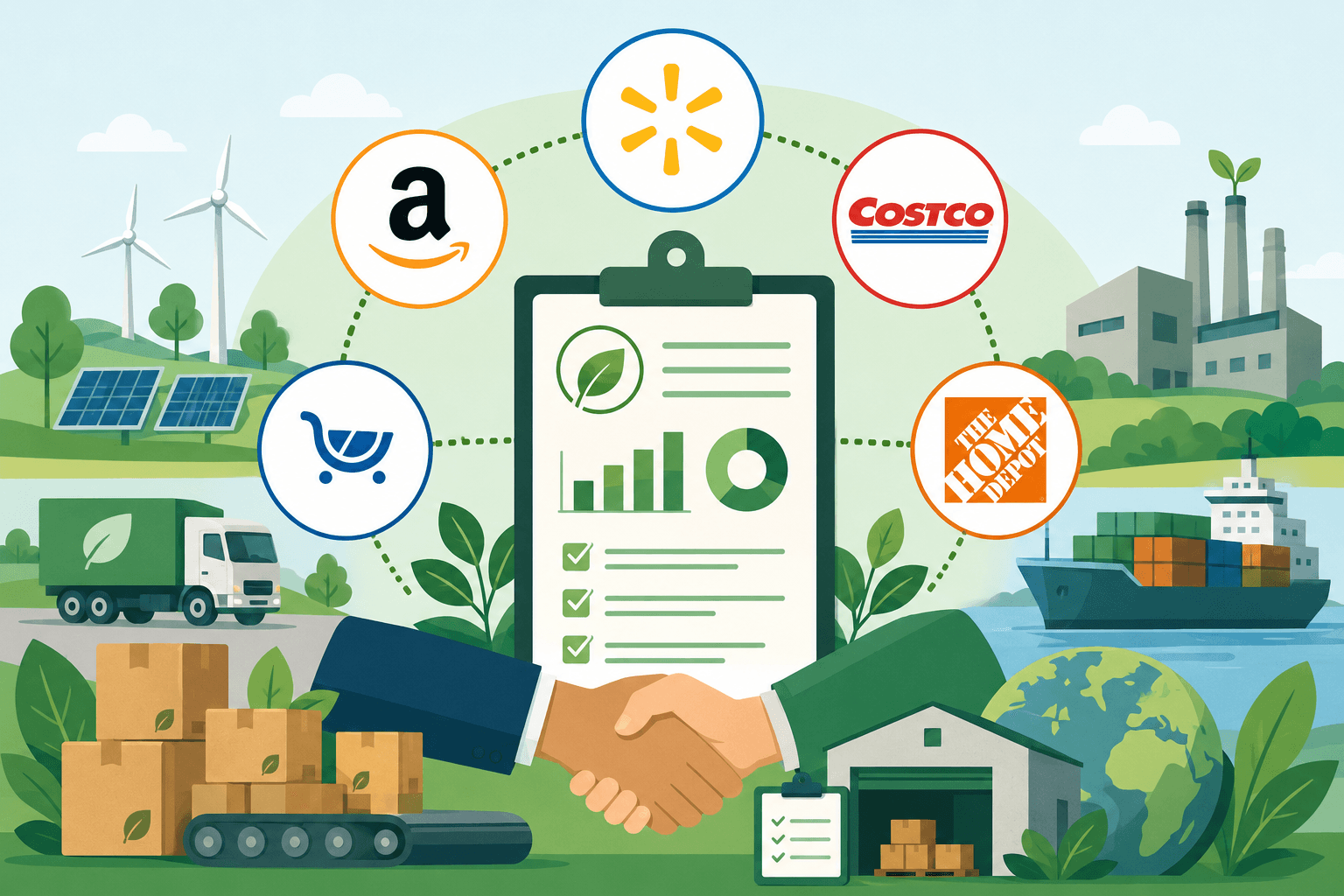
Selling to Walmart, Amazon, Costco, Kroger, or Home Depot? Each retailer has distinct sustainability and carbon reporting expectations for suppliers. This guide breaks down exactly what each retailer requires, what platforms they use, and how to prepare your emissions data before the next vendor review.
Read Article
Getting requests for your company's sustainability data from customers, partners, or procurement teams? This practical guide walks you through exactly what to measure, how to organize your emissions data, and how to respond to common sustainability questionnaires without hiring a full ESG team.
Read Article
Talk with a Sustainability Expert, see a demo, or start free to put the Aclymate platform and experts to work for your team.