← Back to Insights
Bill Zujewski
July 14, 2026
If you run or manage sustainability for an apparel or fashion brand, your biggest emissions challenge is not in your offices or your showrooms. It is in your supply chain — often several tiers deep, across cotton fields, spinning mills, dyehouses, and container ships spanning six continents before a garment reaches a consumer. That is not a generic Scope 3 challenge. It is an apparel-specific Scope 3 challenge, and it requires carbon accounting software designed for it.
Industry data consistently shows that over 90% of a fashion brand's total emissions fall under Scope 3 — primarily Category 1, purchased goods and services. Spend-based estimation, the default method in most general-purpose platforms, is structurally inadequate for capturing the emissions differences between a recycled polyester T-shirt and a virgin cotton one, or between a supplier running on renewable energy and one on coal-fired power. The software you choose determines not just how you report, but how accurately your data reflects what is actually happening in your value chain.
This article covers what the best carbon accounting software for apparel and fashion companies needs to do, which platforms are purpose-built for the industry versus which are strong accessible alternatives — including Aclymate, which explicitly serves apparel firms and promotional product companies — and what to look for in data handling, supply chain coverage, and ERP and accounting integrations including QuickBooks, SAP, and PLM systems.
In most industries, Scope 3 Category 1 (purchased goods and services) is one of several material categories. In fashion, it is nearly everything. Research consistently shows that 80–96% of a fashion brand's emissions sit in Scope 3.1 — the raw materials, wet processing, garment assembly, and packaging that make up your product catalog. As Aclymate's own industry guide notes, in fashion "Scope 3 is the heavy hitter" — encompassing embodied carbon in raw materials, supply chain manufacturing, and logistics that dwarfs everything else in the footprint.
This means spend-based Scope 3 estimation — where emissions are calculated by multiplying financial spend by an industry-average emission factor — is not just imprecise; it is actively misleading. A dollar spent on recycled polyester and a dollar spent on virgin wool look identical to a spend-based model but carry vastly different emission profiles. Any software that defaults exclusively to spend-based Scope 3 for fashion supply chains produces a number that cannot reliably support a decarbonization strategy, an SBTi target, or a CSRD disclosure.
A single garment can contain dozens of components — multiple fabric types, trims, labels, thread, and packaging — each sourced from different suppliers in different countries and processed through different energy regimes. Generic carbon platforms are not designed to handle bill-of-materials (BOM) data at the component level, which means they cannot calculate a product carbon footprint that holds up to scrutiny. Fashion-specific platforms are built around this structure: they ingest BOM data, apply fabric- and process-specific emission factors, and attribute emissions at the SKU level.
Most fashion brands have direct relationships with Tier 1 suppliers (manufacturers), but emissions-intensive activities often happen at Tier 2 (fabric mills), Tier 3 (yarn producers), and beyond. A platform that can only collect data from Tier 1 suppliers will systematically undercount Scope 3.1. Better platforms provide supplier engagement workflows that extend data collection upstream, and use LCA-based estimation to fill gaps where primary data is unavailable. This multi-tier depth is also what the EU's Digital Product Passport and Green Claims Directive will require for product-level traceability.
Generic platforms use broad industry-average emission factors from databases like DEFRA or EPA. These are designed for cross-industry comparability, not fashion-supply-chain precision. Fashion-specific platforms maintain libraries of fiber- and process-specific emission factors that distinguish between organic and conventional cotton, between ring-spun and air-jet yarn, between wet processing in China versus Portugal. The difference can shift a product's calculated footprint by 40–60%. For apparel brands — as Aclymate's apparel Scope 3 guidance highlights — LCA databases for materials combined with supplier surveys are the recommended approach for getting Scope 3.1 right.
The platforms below range from fashion-specific to accessible SME-focused alternatives. Each is assessed honestly with real strengths and limitations. For a side-by-side summary, jump to the comparison table.

Aclymate is explicitly built for and trusted by apparel firms, CPG brands, and promotional product companies — industries where product complexity and supply chain Scope 3 are real problems, but dedicated sustainability staff are rare. It positions itself as software + experts + certifications, which is a direct answer to the most common failure mode in apparel carbon accounting: companies buy a platform, get stuck configuring methodology decisions they are not qualified to make, and end up with a number they cannot defend.
The platform tracks Scope 1, 2, and 3 emissions using both activity-based and spend-based methods — using activity data (such as material quantities and mileage) where available, and spend-based estimates as a documented fallback. For apparel Scope 3 supply chain reporting, Aclymate invites vendors to complete supplier emissions surveys, improving upstream data quality beyond what spend-based estimates alone can produce. Its Climate Bookkeeper service — where an expert manages data gathering, supplier outreach, and compliance reporting on the client's behalf — is the core differentiator for brands that cannot run this process internally.
Aclymate integrates natively with QuickBooks and major accounting software and utility providers, making it accessible to apparel brands running their finances on standard SME tools rather than enterprise ERPs. It generates reports and certifications accepted by CDP, EcoVadis, and B Corp — the three most common certification pathways for mid-market apparel brands under retailer or investor pressure to demonstrate sustainability credentials. It also includes a verified offset marketplace for brands building a net-zero strategy alongside their reporting, and its pricing is designed for SME budgets from startups to companies with up to 10,000 employees.
For apparel brands navigating growing regulatory requirements — California SB 253/261, CSRD supply chain reporting obligations, retailer sustainability scorecards — Aclymate's Turn Key service means the brand does not need to become an expert to produce a credible, defensible report. The sustainable fashion guide published by Aclymate outlines exactly how apparel brands should approach measurement, certification, and supplier engagement in 2026.
Best for: US-based small-to-mid-market apparel brands, promotional product companies, and branded merchandise businesses that need GHG Protocol-aligned Scope 1–3 tracking with expert support included, QuickBooks or accounting software integration, and a path to CDP, EcoVadis, or B Corp certification — without an enterprise budget or in-house sustainability team.
Honest limitation: Aclymate is built for accessibility and expert-guided support first. It is not a fabric-level LCA platform. Brands with large, complex product catalogs requiring component-level BOM data, multi-tier supplier data pipelines into SAP or a PLM system, or CSRD reasonable-assurance-grade Scope 3.1 depth will eventually need to graduate to a fashion-specific platform like Carbonfact or Carbon Trail. Aclymate is the right starting point — not necessarily the final destination — for brands at that scale.
Carbonfact is purpose-built for the apparel and footwear industry and is the most technically mature fashion-specific platform available. Its core differentiators are product-level LCA at scale and a library of over 150,000 fashion-and-region-specific emission factors. The platform ingests BOM and purchase order data, automatically enriches it using AI trained on millions of apparel LCAs, and attributes emissions at the SKU, component, material, and process level. Methodology is audited annually by PwC and aligned with the GHG Protocol, ISO 14040, and PEFCR Apparel and Footwear standards.
Carbonfact integrates directly with enterprise ERPs (SAP, Oracle, Microsoft Dynamics) and PLM systems (Centric, Lectra, PTC) via custom connectors. It generates audit-ready outputs for CSRD, CDP, SBTi, and Digital Product Passports. Brands like GANNI, Marc O'Polo, ARMEDANGELS, and A.P.C. use the platform.
Best for: Mid-to-large fashion and footwear brands with complex product catalogs, ERP/PLM infrastructure, and a need for product-level LCAs, multi-tier supplier data, and CSRD reasonable assurance.
Limitation: Enterprise pricing and implementation complexity. Not suited to small brands building a first GHG inventory who need a simpler, faster starting point.
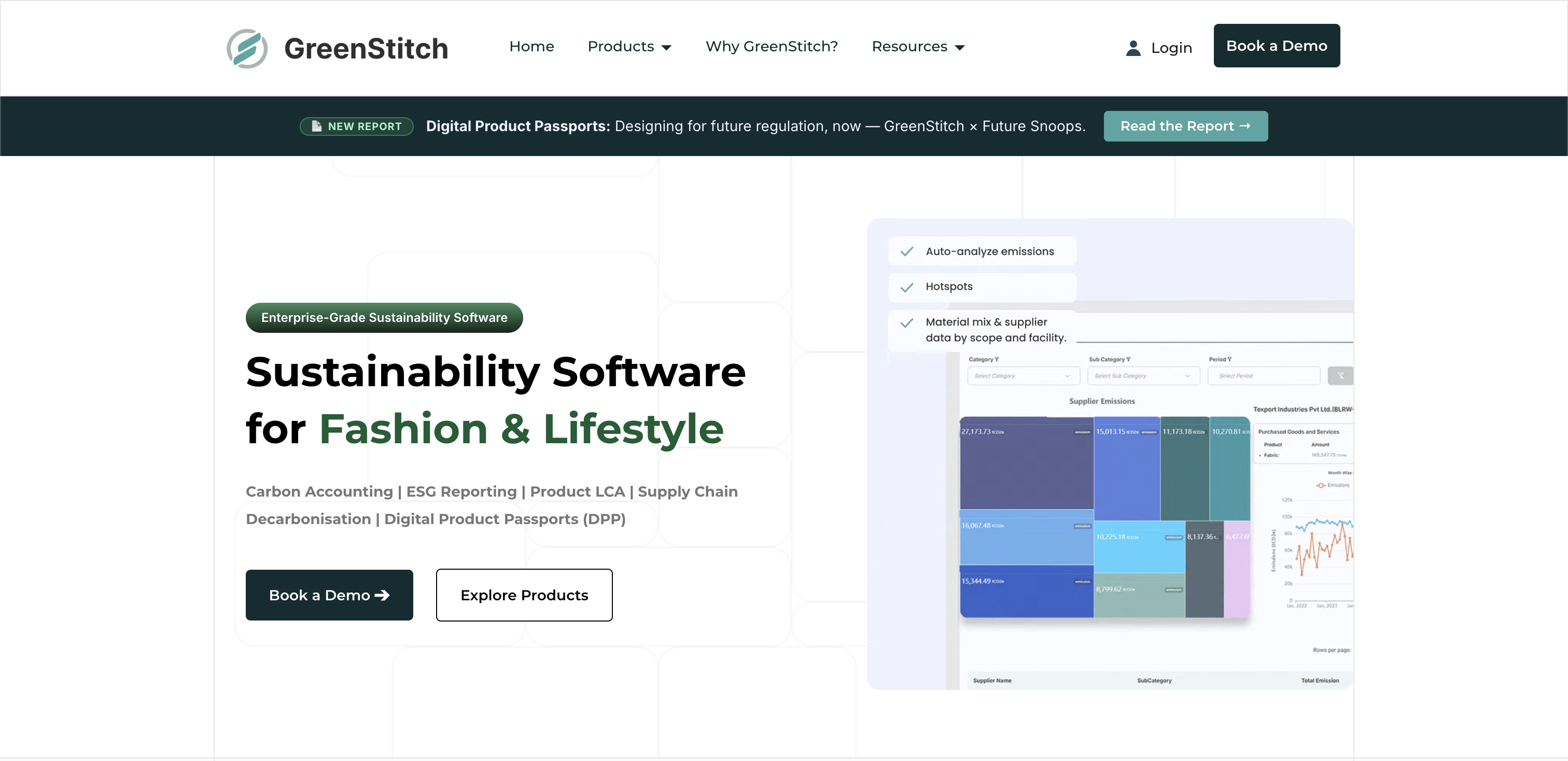
GreenStitch is fashion-purpose-built, covering all 15 GHG Protocol Scope 3 categories with activity-based calculations specific to textiles and apparel. It offers fabric-specific emission factors, supplier-level hotspot reporting, and built-in scenario modelling that lets brands simulate the emissions impact of switching materials, changing suppliers, or localising production before committing. It integrates with PLM, ERP, and procurement systems, and generates compliance outputs for GRI, CSRD, CDP, SBTi, and BRSR. It positions as affordable relative to enterprise fashion platforms, making it viable for brands that need fashion-specific accuracy without Carbonfact-level implementation overhead.
Best for: Fashion brands of all sizes that want activity-based Scope 3 accuracy, scenario modelling for decarbonization planning, and PLM/ERP integration.
Limitation: Less established than Carbonfact in third-party methodology audits and published brand references. Worth requesting independent methodology verification during evaluation.
Carbon Trail specializes in AI-assisted apparel and footwear LCAs aligned to the GHG Protocol and PEFCR for Apparel and Footwear (independently verified). Its AI extraction engine ingests unstructured data from PDFs and spreadsheets, fills data gaps with documented proxy values, and enables structured data collection across Tier 1 and deeper supply chain tiers via a dedicated supplier portal. It supports CSRD, GRI, CDP, TCFD, and Digital Product Passport outputs, with what-if scenario modelling at product and organizational level.
Best for: Fashion and footwear brands with complex multi-tier supply chains needing AI-assisted LCAs, primary supplier data collection, and a route to CSRD and DPP product-level compliance.
Limitation: Implementation depth comes with setup complexity. Brands without any existing sustainability data infrastructure need a setup phase before producing a first report.
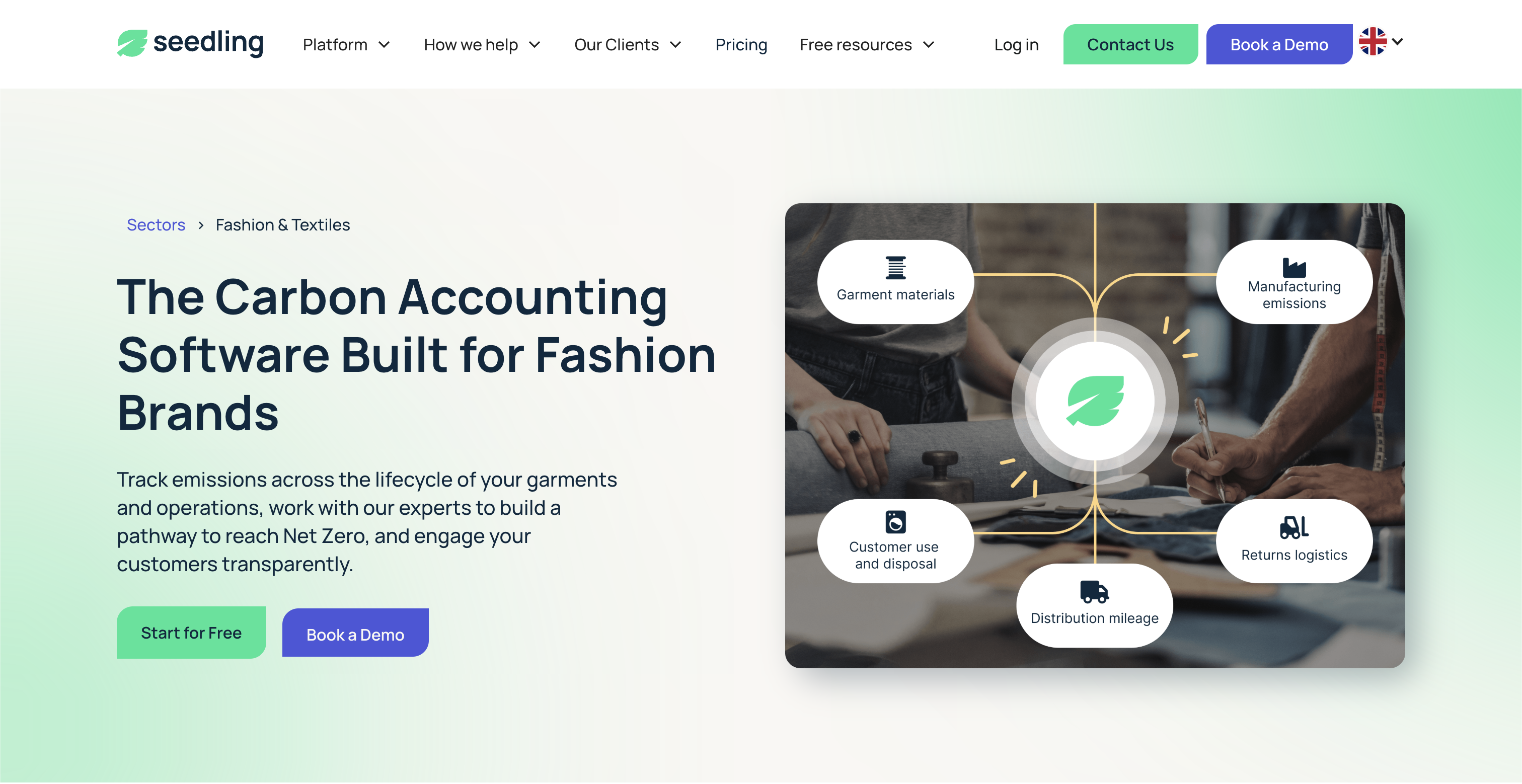
Seedling was built in partnership with the British Fashion Council for fashion SMEs specifically. It collects activity-based supplier data — garments made, transport modes, materials used — producing more accurate Scope 3 footprints than spend-based approaches, and integrates with QuickBooks, Xero, and Sage. It generates SBTi-aligned targets, B Corp assessments, EcoVadis compliance, and SECR reporting, and is competitively priced for smaller brands.
Best for: UK/EU SME fashion brands wanting activity-based Scope 3 accuracy and expert support without enterprise overhead.
Limitation: Less suited to large product catalogs, complex multi-tier supply chains, or brands with product-level LCA requirements. Primarily UK/EU market focus.
The integration question for apparel companies is more nuanced than for most industries, because the data needed for accurate Scope 3 measurement lives in at least three different places: your financial systems (spend data), your product management systems (BOM and material data), and your supplier systems (production activity and energy data). No single integration covers all three.
Aclymate and Seedling connect to QuickBooks Online/Desktop, Xero, and Sage via API. These integrations pull transaction-level spend data and convert it to emissions estimates using spend-based carbon accounting methods. For apparel brands, this gives a fast, low-friction Scope 3 baseline — your total purchasing spend mapped to emission factors — but it does not distinguish between different materials, suppliers, or production processes. It is the starting point, not the destination.
When QuickBooks integration is enough: You need a first GHG inventory quickly, are pursuing B Corp, EcoVadis, or CDP certification, and do not yet have structured BOM or supplier activity data.
When you need to go further: You are heading toward CSRD, SBTi science-based targets, product-level carbon claims, or a reasonable-assurance threshold requiring activity-based data rather than spend-based proxies.
Enterprise ERP integrations unlock a much richer data set: purchase orders, bills of materials, logistics records, energy consumption by facility, and production volumes. Platforms like Carbonfact and Carbon Trail build custom connectors to SAP, Oracle, and Microsoft Dynamics, enabling automated data pipelines for activity-based Scope 3.1. For mid-market brands on NetSuite, ask vendors directly about connector availability. Aclymate's Turn Key service bridges this gap for brands without ERP infrastructure by having Climate Bookkeepers collect and structure the same underlying data manually from supplier surveys and exports.
PLM systems hold the data that makes product-level carbon accounting possible: BOMs at the component level, material specifications, supplier assignments, and production routing. PLM integration is the most powerful integration for fashion Scope 3.1 accuracy. Carbonfact supports Centric, Lectra, and PTC; GreenStitch supports ERP and PLM integration as a core capability; Carbon Trail ingests PLM exports via its AI extraction engine. For brands without a PLM, Aclymate's vendor survey approach and activity-based intake captures material and process data in a structured way without requiring a PLM system first.
| System | Platforms That Support It | What It Unlocks | Best For |
| QuickBooks Online/Desktop | Aclymate, Seedling | Spend-based Scope 3 from financial transactions — fast first baseline | US apparel SMEs without ERP |
| Xero / Sage | Seedling, Normative | Transaction-level spend data, strong UK/EU accounting ecosystem | UK/EU SME fashion brands |
| SAP / Oracle / NetSuite | Carbonfact, Carbon Trail | Activity-based BOM, PO, logistics, and energy data for accurate LCAs | Mid-to-large brands with ERP |
| PLM (Centric, Lectra, PTC) | Carbonfact, GreenStitch, Carbon Trail | Component-level material and process data for product-level LCAs | Fashion brands with product complexity |
| Supplier portals / API | Carbon Trail, GreenStitch, Aclymate (vendor surveys) | Primary Tier 1–2 supplier data for activity-based Scope 3.1 | Brands building supplier data programs |
Accurate Scope 3 measurement for apparel companies follows a specific sequence. The GHG Protocol Corporate Value Chain Standard is the starting framework, but the fashion industry's category concentration in Scope 3.1 makes the approach more specific than most.
Most small and mid-market apparel brands do not have a dedicated sustainability hire. The person responsible for carbon reporting is often also responsible for sourcing, compliance, or finance — and has neither the time to become an LCA expert nor the budget for a separate sustainability consulting firm.
The practical answer is to prioritize platform choice based on what the vendor's service model does for you, not just what the software can theoretically do:
In all cases, ask vendors the same question: what does the first reporting cycle actually look like for a company our size, with our current data setup, and without a dedicated sustainability team? The answer — not the feature list — is the most reliable signal of fit. You can also take Aclymate's 2-minute sustainability readiness quiz to get a personalized scorecard and next steps specific to your business profile.
$ = lowest cost tier, $$$$ = enterprise. 'Expert guidance included' means sustainability methodology support is part of the platform fee, not a separate consulting engagement. See the evaluation checklist in the FAQ for what to test during a vendor demo.
| Platform | Best For | Core Strength | Key Integrations | Pricing Tier |
| Aclymate | SME to mid-market apparel (US) | Software + Climate Bookkeepers, activity- & spend-based, QuickBooks integration | QuickBooks, accounting software, utilities | $-$$ |
| Carbonfact | Mid-to-large fashion/footwear | Product LCAs, 150K+ fashion emission factors, ERP/PLM pipelines | SAP, Oracle, MS Dynamics, Centric, Lectra | $$$-$$$$ |
| GreenStitch | Fashion brands, all sizes | All 15 GHG Protocol categories, activity-based, ERP/PLM integration | ERP, PLM, procurement systems | $$-$$$ |
| Carbon Trail | Fashion/footwear, multi-tier SC | AI-powered LCAs, PEFCR Apparel, supplier data portal | API, AI ingestion from PDFs/spreadsheets | $$$ |
| Seedling | SME fashion brands (UK/EU) | Activity-based supplier data, full-scope, GHG Protocol aligned | QuickBooks, Xero, Sage | $$ |
If you are an apparel or fashion brand evaluating carbon accounting software and want to see how Aclymate handles Scope 3 supply chain measurement for companies without a dedicated sustainability team — including QuickBooks integration, supplier vendor surveys, and certification-ready outputs for CDP, EcoVadis, and B Corp — request a demo. We'll walk through your specific emissions sources, show how the platform structures Scope 3 data for an apparel business, and show what a compliance-ready report looks like before you commit to anything.
Not ready for a demo yet? Start with the sustainability readiness quiz to see where your brand stands, or explore Aclymate's pricing to understand the options. Still have questions? Check the FAQ below.
What is the best carbon accounting software for apparel and fashion companies?
It depends on your company size and technical setup. For US apparel SMEs and mid-market brands without a sustainability team, Aclymate is the strongest fit: it explicitly serves apparel firms, includes expert Climate Bookkeepers, integrates with QuickBooks, and produces CDP, EcoVadis, and B Corp-ready reports at SME pricing. For fashion brands needing product-level LCAs, fabric-specific emission factors, and ERP/PLM data pipelines, Carbonfact is the most established fashion-specific enterprise platform. GreenStitch and Carbon Trail are strong fashion-specific alternatives with ERP integration. For UK/EU fashion SMEs, Seedling — built with the British Fashion Council — is purpose-built for this profile.
Is Aclymate good for carbon accounting for apparel and fashion companies?
Yes — for the right buyer profile. Aclymate explicitly serves apparel firms and promotional product companies, and its platform is well-suited to the most common challenge in this space: brands that have real supply chain Scope 3 complexity but no in-house sustainability expert to manage it. Its Climate Bookkeeper service handles data gathering, supplier outreach, and compliance reporting on your behalf, and its vendor survey tool captures supplier emissions data to improve Scope 3 accuracy beyond spend-based estimates. It tracks Scope 1, 2, and 3 using both activity-based and spend-based methods, aligned with the GHG Protocol. The honest boundary: Aclymate is not a fabric-level LCA platform. Brands needing component-level BOM data, multi-tier supplier data pipelines, or CSRD reasonable-assurance-grade Scope 3.1 depth will eventually need a fashion-specific enterprise platform. But for the majority of apparel SMEs building their first or second GHG inventory, Aclymate is the most practical and expert-supported option available.
What carbon accounting software integrates with QuickBooks for fashion brands?
Aclymate integrates with QuickBooks and other major accounting software and utility providers. Seedling integrates with QuickBooks, Xero, and Sage. These integrations pull financial transaction data to generate spend-based Scope 3 estimates — a solid starting point for a first GHG inventory, though activity-based supplier data collection (via vendor surveys or supplier portals) is needed to reach the Scope 3.1 accuracy that fashion brands ultimately require.
What carbon accounting software integrates with SAP or ERP systems for apparel?
Carbonfact builds custom connectors to SAP, Oracle, and Microsoft Dynamics for automated BOM and purchase order data pipelines. Carbon Trail ingests data from any ERP via API or its AI extraction engine. GreenStitch integrates with ERP and procurement systems. For mid-market apparel brands without a full enterprise ERP, Aclymate's Turn Key service replicates this through structured supplier surveys and expert-managed data collection, without requiring ERP infrastructure first.
Why can't I just use a generic carbon accounting platform for my apparel brand?
Generic platforms use industry-average emission factors that cannot distinguish between different fiber types, production regions, or manufacturing processes — the variables that drive most emissions variance in fashion supply chains. A spend-based estimate treats a dollar spent on organic cotton the same as a dollar spent on virgin polyester. This produces a company-level GHG number that is defensible as a rough first estimate, but cannot support product-level claims, supply chain decision-making, SBTi target verification, or CSRD reasonable assurance. For apparel brands, the accuracy of emission factors and the ability to attribute emissions at the material and process level is the core of what makes carbon accounting useful, not just compliant.
How do I measure Scope 3 emissions accurately for a fashion brand without a large team?
Start with a GHG Protocol Scope 3 relevance screening focused on Category 1 (purchased goods), Category 4 (upstream transport), and Categories 11–12 (use and end-of-life). Use representative products to build a defensible first Scope 3.1 estimate. Collect activity-based supplier data — material quantities, energy use, transport modes — using vendor surveys or a supplier portal. Choose a platform that supports multiple calculation methods per category. And use a vendor whose experts guide you through methodology choices, rather than expecting your team to make those decisions alone. Aclymate's Climate Bookkeepers are specifically designed to manage this process for apparel brands without in-house sustainability staff.
Do I need product-level carbon accounting or is a company-level GHG inventory enough?
A company-level GHG inventory — covering Scope 1, 2, and Scope 3 by category — satisfies most current disclosure frameworks including CSRD ESRS E1 at the organizational level, CDP, and SBTi target-setting. Product-level carbon footprints are required for the EU's Digital Product Passport, the Green Claims Directive, and any brand making per-garment environmental claims. If you sell into EU retail channels or have enterprise retailer customers requiring product-level data, the timeline to product-level carbon accounting is shorter than most brands expect. Starting with a platform that can grow from company-level to product-level without a platform switch is worth prioritizing.
What certifications can I get through carbon accounting for my apparel brand?
The most common certification pathways for apparel brands are CDP disclosure and scoring (used by major retailers and enterprise buyers to evaluate supplier sustainability), EcoVadis sustainability ratings (increasingly required in B2B supply chains), and B Corp certification (which now requires annual GHG Protocol-aligned Scope 1–2–3 reporting). Aclymate supports all three, and also offers its own tiered Aclymate certifications for brands building a documented sustainability program. SBTi validation is the pathway for brands committing to science-based reduction targets, and requires a company-level GHG inventory as the foundation.
What are the growing regulatory requirements for apparel brand carbon reporting?
The regulatory landscape for apparel brands is tightening on multiple fronts. In the EU, CSRD mandates Scope 1, 2, and 3 reporting with limited assurance for covered companies. California SB 253 requires large companies doing business in California to disclose Scope 1, 2, and 3 emissions. Retailer sustainability scorecards from large buyers increasingly require CDP or EcoVadis data from suppliers. And the EU's Digital Product Passport and Green Claims Directive will require product-level carbon data for goods sold in the EU. Aclymate's regulations page provides an up-to-date overview of how these requirements apply to growing businesses.
Carbon accounting for apparel and fashion brands is a supply chain data problem before it is a software problem. The platform you choose either has the emission factors, integration architecture, calculation methodology, and expert service model to solve it properly — or it does not.
For the majority of US apparel SMEs and mid-market brands: Aclymate is the most practical answer. It is explicitly built for apparel and promotional product companies, includes expert Climate Bookkeepers, integrates with QuickBooks, and produces certification-ready reports for CDP, EcoVadis, and B Corp without requiring a sustainability hire. It is where most apparel brands in this segment should start.
For brands with large product catalogs, ERP or PLM infrastructure, and a path toward product LCAs and CSRD reasonable assurance: Carbonfact or Carbon Trail will give you the depth to scale without switching platforms. For UK/EU fashion SMEs: Seedling is purpose-built for your market. For fashion-specific accuracy with ERP integration at a mid-market price point: GreenStitch is worth a close look.
The evaluation question is the same in every case: can this platform tell me, with a defensible methodology and documented evidence trail, what is driving Scope 3.1 in my supply chain — and what would change if I switched a supplier or a material? If the answer is yes, and an assurance provider could verify it, you have found the right tool. Use the comparison table above to structure your shortlist, and request a demo to see how Aclymate handles it for an apparel business your size.
Get Aclymate's practical sustainability content delivered weekly.

Looking for a Watershed alternative? Compare Aclymate, Persefoni, Sweep, Plan A, Greenly, and Normative to find the best carbon accounting platform for your reporting, compliance, and sustainability goals.
Read Article

EHS, ESG, and sustainability software often overlap, but they solve different problems. Learn which type of platform your company actually needs.
Read Article
Learn the signs your business may need a climate consultant, from customer requests and Scope 3 emissions to reporting, certifications, and sustainability strategy.
Read Article
Talk with a Sustainability Expert, see a demo, or start free to put the Aclymate platform and experts to work for your team.